
Increasingly, companies are showing a greater awareness of the importance of recycling industrial plastics. Recycling emerges as one of the most effective solutions to address the issue of waste accumulation while allowing for the direct or indirect utilization of these products.
It is crucial for recycling to become a fundamental pillar in the processes and business plans of large companies, as it plays a positive role in sustainable development.
Unfortunately, many companies are still unaware of the multiple benefits associated with the collection, transportation, and management of industrial plastics, not only for the environment but also for the economy as a whole.
In summary, recycling always presents itself as a smart investment. In this article, we will explain in detail the economic advantages of embracing the recycling of industrial plastics.
Why is it crucial to recycle plastic?
One of the most environmentally harmful materials is plastic because its decomposition process is extremely slow, taking between 100 and 1000 years to fully break down.
Plastic is a petroleum-derived polymer, a non-renewable resource. For this reason, it is essential to promote its recycling, both to preserve the environment and to reduce the costs associated with its production.
It is important to understand that industrial plastic is used in the manufacturing of consumer product packaging, credit and debit cards, identification cards for businesses, universities, or schools, as well as in food and beverage preservation, toy production, and clothing manufacturing.
Currently, there are more than 10,000 different types of plastics worldwide, demonstrating their versatility when combined with other materials, further expanding their applications.
Another noteworthy fact is that up to 10% of the total waste stream consists of petroleum-derived products. This means that the more petroleum is used in plastic production, the higher the greenhouse gas emissions into the atmosphere.
Imagine the magnitude of the problem, especially when only 5% of all available plastic is recycled.
Reasons for Companies to Recycle More Industrial Plastics
Recycling industrial plastics offers numerous benefits to industries:
- Reduction in raw material costs by reusing discarded products.
- Lower production costs by avoiding starting from scratch.
- Reduction of environmental pollution.
- Minimization of CO₂ emissions throughout the manufacturing process.
- Enhancement of corporate image, both in the eyes of customers and as part of their social and corporate responsibility.
Recycling plastics also provides benefits to the planet:
- Using recycled products reduces energy consumption, resulting in decreased CO₂ emissions into the atmosphere. For every kilogram of recycled plastic, approximately 1.5 kilograms of CO₂ emissions are avoided.
- Furthermore, recycling prevents the exploitation of natural resources by giving a second purpose to products that have already been processed.
Lastly, this practice offers benefits to humanity:
- It serves as an education for future generations.
- It reduces expenses on product acquisition, as they are obtained through recycling.
- It offers prospects for the circular economy.
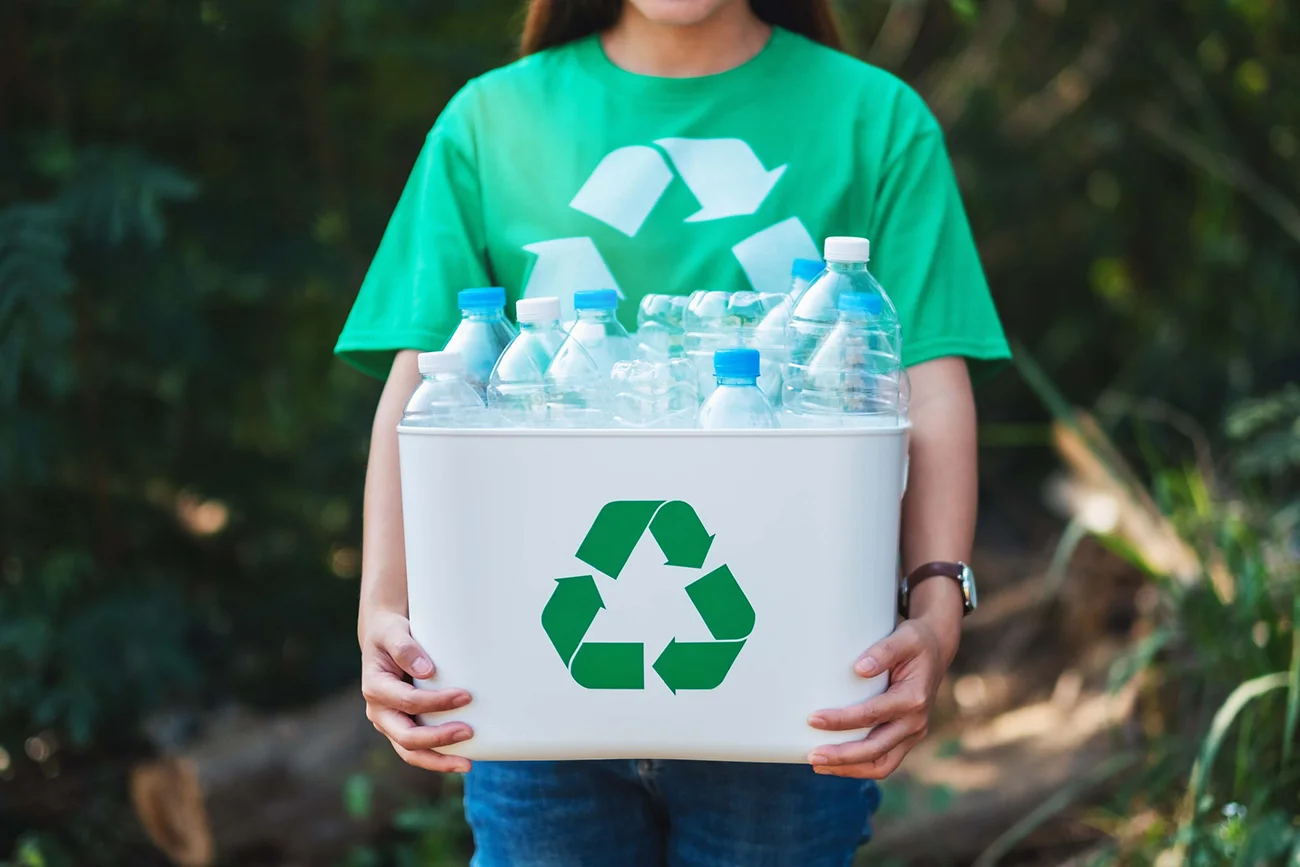
Reasons for Companies to Increase Their Recycling Efforts
- It can help reduce production costs since recycled plastic is often more cost-effective than virgin plastic.
- Additional revenue: Income is generated by selling recycled plastic to other companies that use it as raw material.
- Compliance with regulations: Companies may receive tax incentives or regulatory advantages for recycling their industrial waste.
Therefore, the management of a discarded plastic bottle at home raises concern for many people. However, in this same context, it is essential to reflect on the fate of the thousands of tons of plastic produced by industries. The circular economy starts with you!